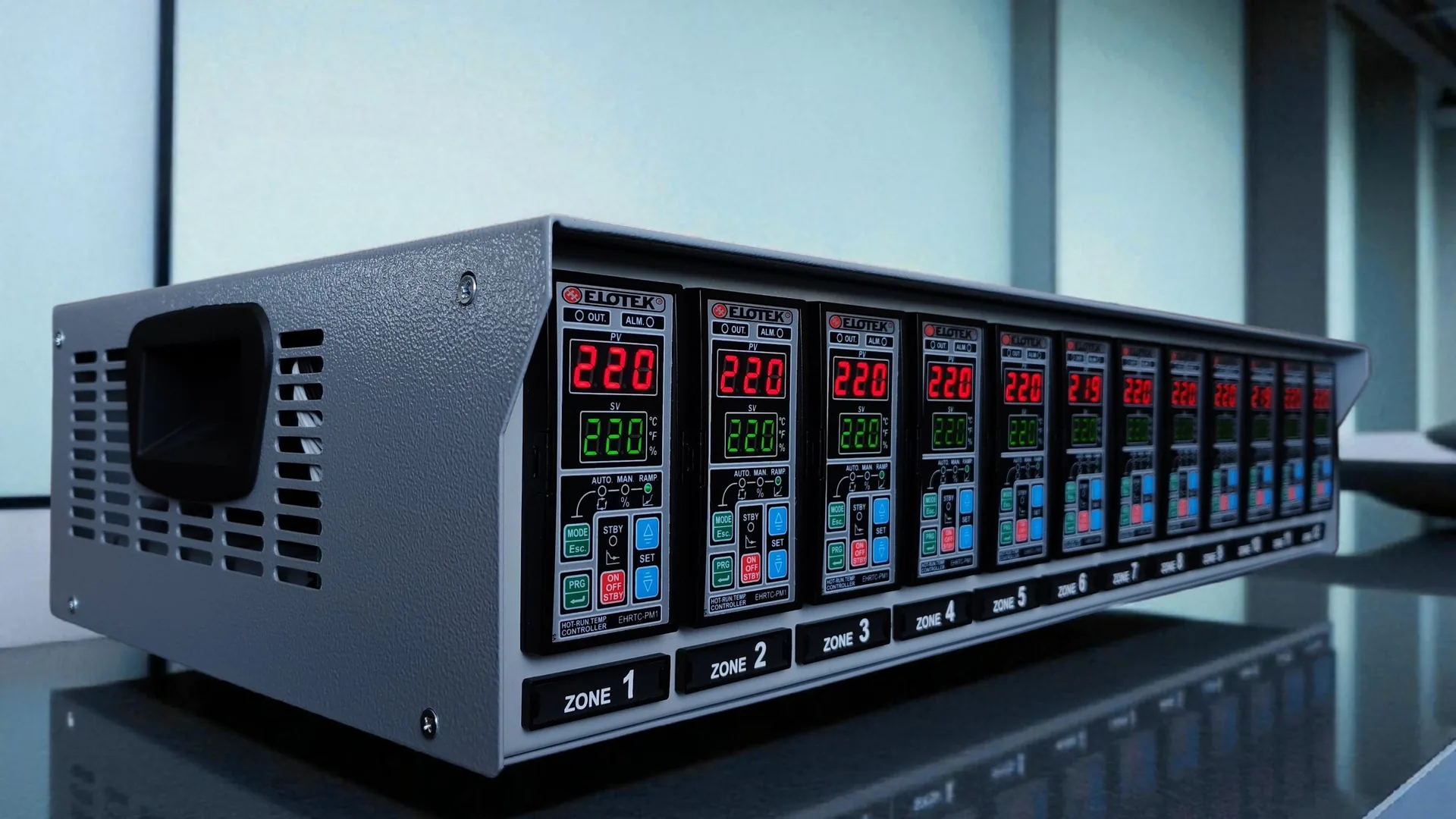
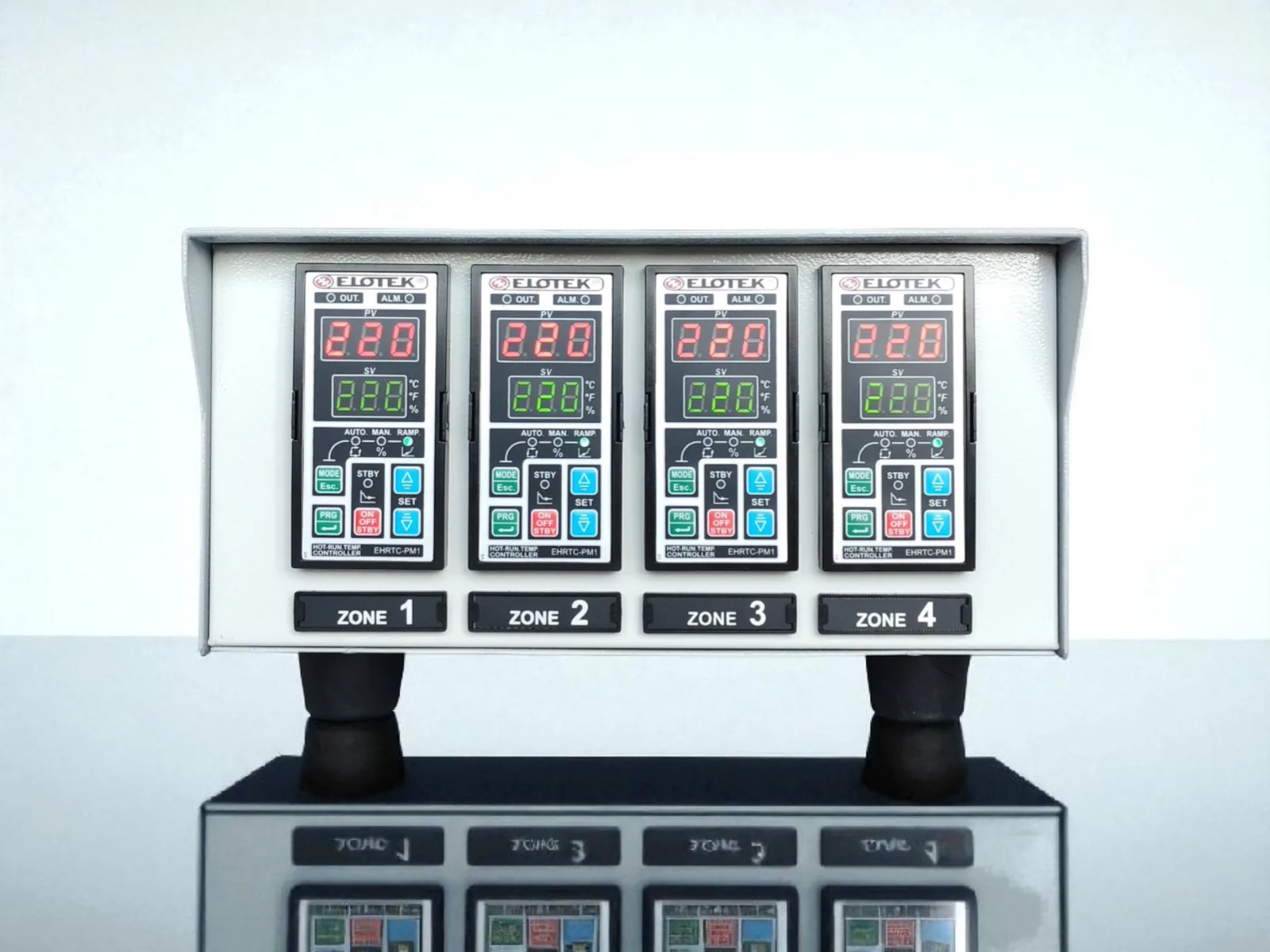
The front panel of a hot runner controller shows two numbers: PV (process value, the measured temperature) and SV (set value, the target). The controller’s only job is to make PV equal SV and keep it there. It does this by answering “how long should the heater be on?” every second, and the algorithm that produces the answer is PID.
Why a simple thermostat is not enough
On/off control (“heat if low, stop if high”) lets the temperature swing ±10–15 °C around the target because of the heater’s thermal inertia. For plastics that means viscosity changes, flash and burn marks. PID sets the output as a percentage: the closer the temperature gets to the target, the shorter the heater stays on.
P, I, D: the three terms
P – Proportional. Output is proportional to the error (SV − PV): large error, full power; small error, little power. P alone settles slightly below the target, because at zero error the output is also zero and heat losses are not covered.
I – Integral. Accumulates the error over time and closes that persistent gap. Too much I overshoots the target and oscillates slowly.
D – Derivative. Watches how fast the temperature changes and cuts the output early when the target is approached quickly. It brakes overshoot, but on a noisy signal it can make the output jitter.
The gains (Kp, Ti, Td) differ from zone to zone: a 200 W nozzle and a 2 kW manifold will not behave well on the same parameters.
What Auto-Tune does
Auto-Tune is the controller measuring and calculating these parameters itself. When started on an EHRTC unit, the controller switches the heater in a controlled pattern, measures the heating rate, dead time and oscillation period, computes Kp, Ti and Td from that data and stores them. The process takes a few minutes depending on the zone’s thermal mass; afterwards the unit returns to normal PID operation.
During Auto-Tune the temperature oscillates around the target a few times; this is normal. Run it before production, with the mould mounted in the machine, so thermal conditions resemble real operation.
When to re-tune
- When the controller is connected to a new mould (each zone)
- When a zone’s heater is replaced with a different rating or type
- When the mould cooling layout changes
- When the temperature reaches the target but keeps oscillating by 3–5 °C
As long as the same controller runs the same mould, the parameters stay valid; there is no need to re-tune at every start-up.
When proportional / manual mode is used
When a thermocouple breaks the controller cannot measure temperature, so PID cannot run. EHRTC units then switch automatically to proportional (percentage) operation: they keep applying the last stable output percentage (say 35 %) and raise an alarm. Production continues under control and you replace the thermocouple at the end of the shift.
The same mode drives a heater without a thermocouple (an auxiliary heater, for example) at a fixed percentage.
Common mistakes
- Auto-tuning a cold mould outside the machine. The parameters will not hold in real operation.
- Tuning all zones at once draws very high power; on large moulds tune zones in groups.
- Entering parameters by hand. Instead of overriding the Auto-Tune result, re-run Auto-Tune; if oscillation persists, check thermocouple contact and the heater.
PID Auto-Tune is standard on EHRTC-PM1 and RM2; the key sequence is in the user manual in the catalog.
This guide was prepared by the Elotek engineering team from field experience with EHRTC installations. Reach us via WhatsApp or e-mail with your questions.