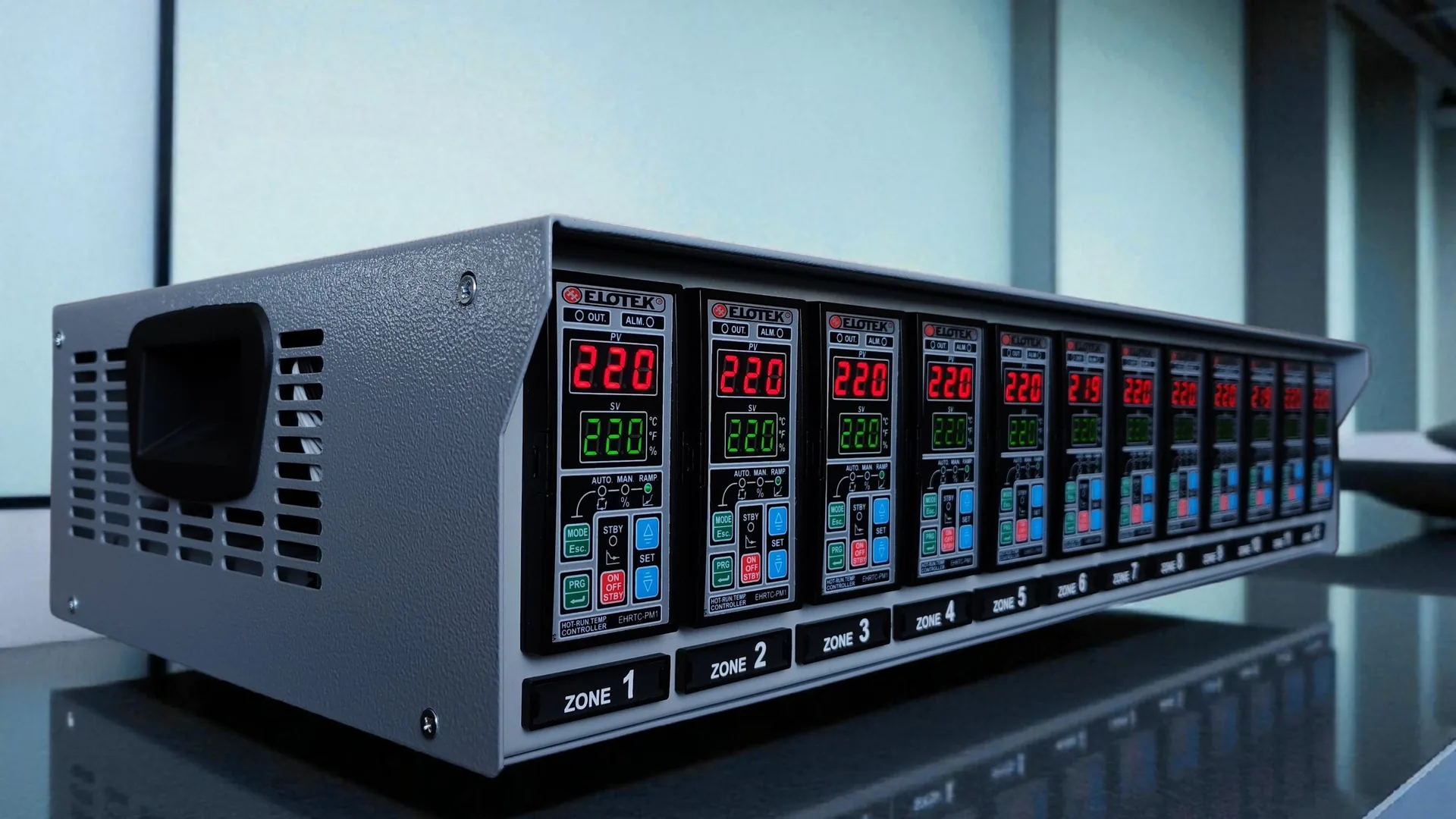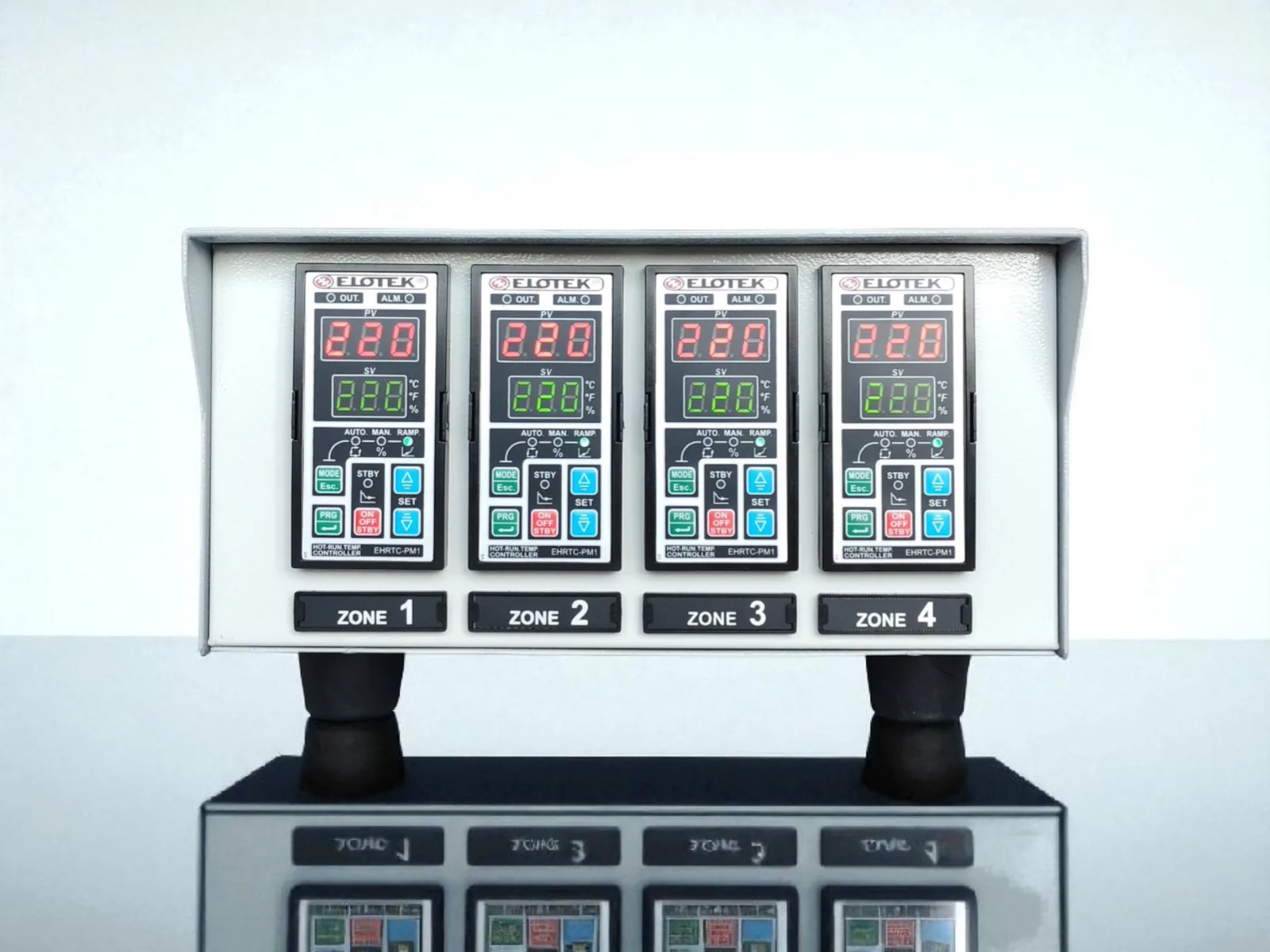
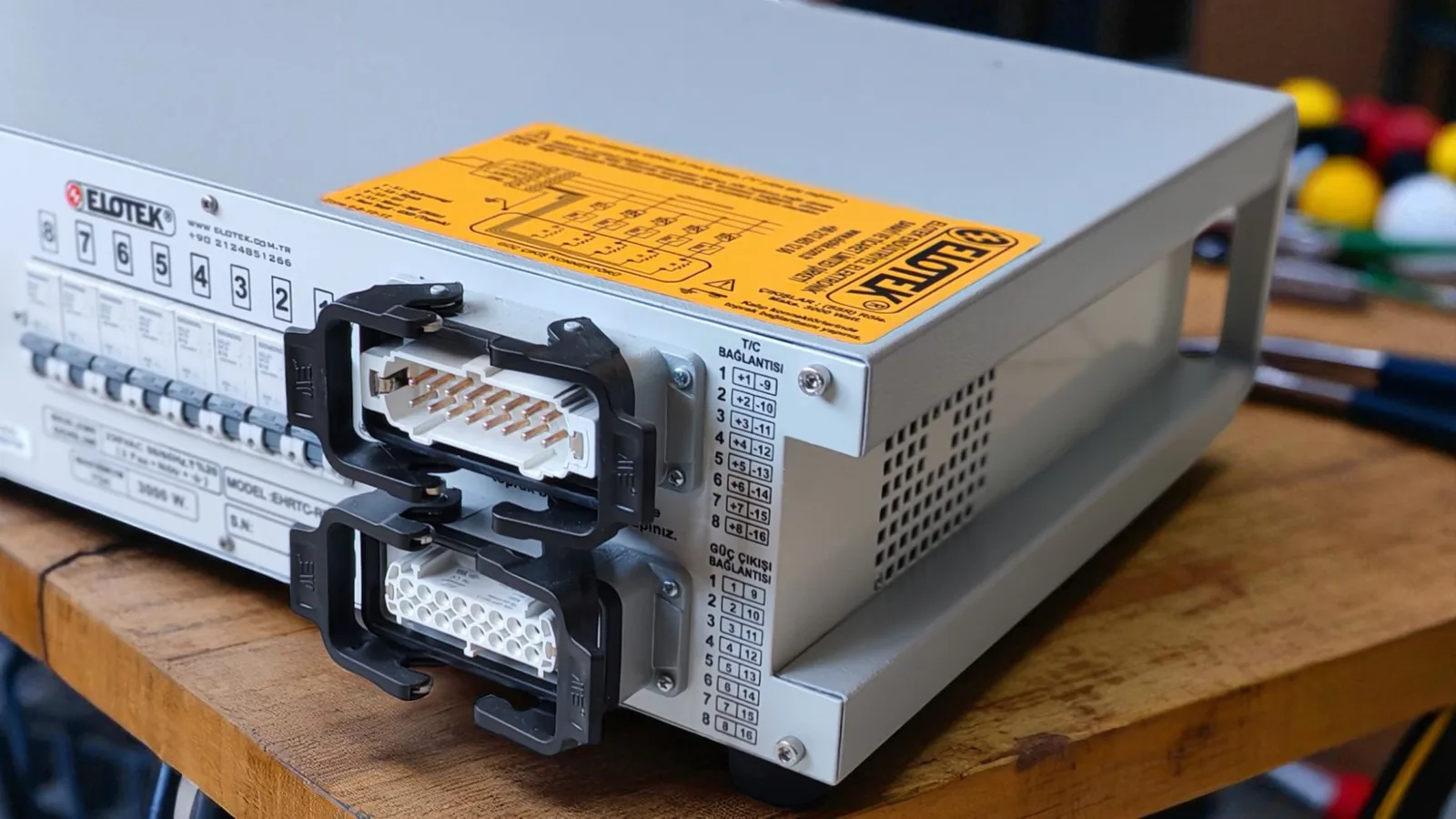
This guide collects the six symptoms EHRTC-PM1 and RM2 users report most often to our service team, with checks that take about 10 minutes on the shop floor. In most cases the fault can be located without removing the controller.
Safety: switch off the zone output before checking cables and connectors. On EHRTC units the output can be switched off with one key without cutting power; for resistance measurements also isolate the panel supply.
1. Thermocouple break alarm (sensor open)
Symptom: The zone alarms, the display shows a sensor error instead of PV, and the controller switches to proportional (percentage) mode.
Likely causes and check order:
- Loose pin or broken wire at the connector: unplug, inspect the pins, check continuity across the thermocouple leads with an ohmmeter (a healthy thermocouple reads a few ohms; open circuit reads infinite).
- Thermocouple wire broken on the nozzle inside the mould: measure at the mould junction box; if it is open there too, the fault is in the mould.
- Cable crushed when the mould closes: inspect the cable route.
Until the thermocouple is replaced, the zone can run in proportional mode; take the output percentage of a similar neighbouring zone as reference.
2. Temperature falling, output at 100 % (reversed polarity)
Symptom: After power-up PV drops below ambient, the zone stays at full power, a low-temperature alarm follows.
Cause: Thermocouple polarity reversed. Swap + and − at the connector or the mould junction box. Do not keep the zone running; the heater will overheat.
3. Deviation alarm (high or low)
Symptom: PV has reached set point but occasionally crosses the alarm limit.
- High deviation: If the temperature rises while the output is off, the SSR may be shorted (see item 6). Heat transfer from a neighbouring zone can also be the cause; review set points.
- Low deviation: Heater underpowered, loose cable or PID parameters not tuned for this mould. Re-run Auto-Tune; if it persists, measure heater resistance.
- Alarm limits may be too tight; ±10 °C is a sensible starting point.
4. Breaker trips
Symptom: The module breaker (16 A) trips immediately or a few minutes after switching the zone on.
- Damp heater: The most common cause after a long stop. Dry it at low temperature with Soft-Start.
- Shorted heater: Measure resistance across the heater leads. Expected value R = V² / P; for 230 V, 800 W that is ≈ 66 Ω. Near zero means a short; insulation resistance (sheath to element) below 1 MΩ means moisture or damage.
- Load above rating: If the heaters on one zone exceed 3200 W, split the zone.
- Crushed cable / sheath contact: Look for bare conductors at the connector and in the mould box.
5. Temperature never reaches set point
Symptom: Output high, PV rises slowly or stays below set point.
- Burnt or partly open heater: Measure resistance; a value far above expected indicates a break.
- Thermocouple in the wrong place: If it has slipped out of the nozzle it measures air; check placement inside the mould.
- Wrong thermocouple type selected: A type J read as type K shows a PV that is too high and the controller throttles early. Check the program setting.
- SSR fault (open): Output LED on but no voltage at the heater means the SSR must be replaced.
- Mould cooling over-cooling the zone: A water channel close to the nozzle can leave the zone underpowered.
6. One zone keeps heating with the output off
Symptom: Output 0 %, LED off, yet PV rises and a high alarm follows.
Cause: The SSR has failed short and drives the heater continuously. Switch the zone off and trip the breaker. On the RM2, remove and ship only that module; on the PM1 the SSR in the external power stage is replaced. Elotek SSRs ship from stock.
When to send it for service
If the checks above point to the controller rather than the mould (heater, thermocouple, cable):
- RM2: Remove only the faulty module; the other zones keep producing.
- PM1: Ship the unit or the external power stage.
Elotek-made units are repaired within 3 business days including parts. Send the model, zone count and symptom via WhatsApp beforehand and we usually have the part ready. Remote support is available through an online technical support session.
This guide was prepared by the Elotek engineering team from field experience with EHRTC installations. Reach us via WhatsApp or e-mail with your questions.